
Oct 12, 2026Buying Guides
Furniture Showroom Display Budget in Europe: A Milan Planning Guide
A practical European furniture showroom budgeting guide, using an illustrative Milan project to compare Prop TVs and working televisions across purchase costs, logistics, installation and supplier.
Furniture Showroom Display Budget in Europe: A Milan Planning Guide
Opening or refurbishing a furniture showroom in Europe requires more than selecting attractive furniture.
Procurement, Visual Merchandising, Store Planning and Finance teams must also decide how the finished room settings will be presented—and how much those display elements will cost to purchase, deliver, install and maintain.
Televisions are a common example.
A showroom may need realistic television-shaped displays beside media cabinets, sofas and bedroom furniture. But those displays do not always need to function as televisions.
Non-functional Prop TVs can be considered when the requirement is visual staging rather than electronic demonstration.
The purchasing decision should be based on the complete project budget, not simply the quoted unit price.
This guide uses an illustrative Milan furniture showroom scenario to explain how European buyers can compare display options, build a cost schedule and prepare a more accurate supplier enquiry.
Planning note: The Milan setting in this article is an example for procurement planning. It is not presented as a verified YIJIA customer project, an audited cost-saving result, or evidence of an actual showroom opening.
1. Define the Role of Every Television Display
Before calculating costs, determine what each television is supposed to do.
A furniture showroom may include several different display environments.
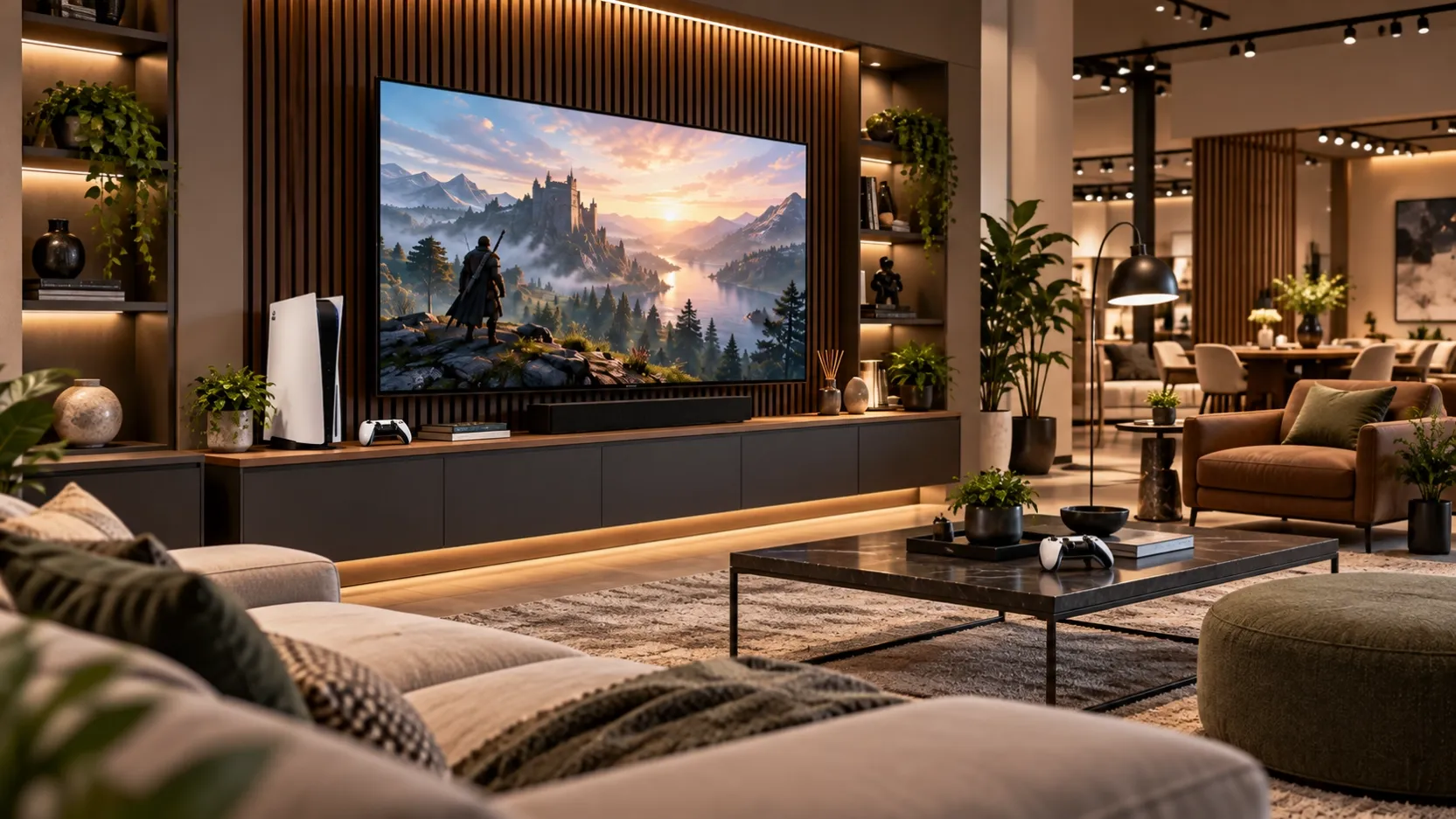
A standard living-room setting may need a television-shaped visual element to complete the media wall.
A premium furniture display may require a larger television to establish scale.
A bedroom may need a smaller unit—or no television at all.
A dedicated technology demonstration, however, may require a working television capable of playing video or running software.
These requirements are not interchangeable.
YIJIA Prop TVs are non-functional display models. They provide the physical appearance of televisions with static screen artwork.
They do not play videos, run streaming applications, or demonstrate electronic features.
For static furniture displays, this may remove some operational requirements associated with working televisions.
But it does not eliminate physical installation, handling, or product care.
For a broader comparison of the two product types, read our Prop TV vs Real TV Cost and Logistics Guide.
The first procurement decision is therefore straightforward:
Does this display need electronic functionality, or does it need to complete the appearance of the room?
2. Illustrative Project: Planning a Milan Furniture Showroom
Consider a hypothetical furniture retailer preparing a new showroom in Milan.
The planned layout contains several living-room concepts, a premium media-wall display, a compact apartment setting, and a few bedroom arrangements.
The Visual Merchandising team wants consistent television-shaped displays that complement the furniture collection.
Procurement must compare two possible approaches:
Option A: Working Televisions
Purchase functional televisions for room settings that may or may not need active screen content.
Option B: Non-Functional Prop TVs
Specify realistic static display models for room settings where electronic functionality is unnecessary.
The project team could also adopt a mixed approach.
Functional televisions might remain appropriate in a demonstration area, while Prop TVs are used in conventional furniture room settings.
There is no requirement to choose only one product type for the entire showroom.
The best decision depends on the purpose of each display and the actual project cost.
3. Build a Room-by-Room Display Schedule
A useful budget begins with a product schedule rather than a total number of televisions.
Different room settings may require different screen sizes, display configurations, and supporting furniture.
An illustrative planning matrix could be:
Display Zone | Screen Size to Review | Purpose |
|---|---|---|
Compact apartment | 43–50 inches | Support smaller entertainment furniture |
Core living-room setting | 55–65 inches | Complete a sofa and media cabinet arrangement |
Premium living-room setting | 70–75 inches | Support wider media furniture |
Flagship media wall | 85–98 inches | Provide large-format visual scale |
Bedroom display | Optional compact size | Add a television only where appropriate |
These are preliminary design categories, not confirmed product quantities or a fixed YIJIA package.
The project team should record the actual number of units required for every room category.
A 65-inch dummy TV may be a useful model to review for core living-room displays, but its suitability should be checked against the cabinet, wall and furniture proportions.
A complete room-by-room schedule should contain:
- Room or display identification
- Selected television size
- Required quantity
- Product model reference
- Frame finish and static artwork
- Wall-mounted or tabletop configuration
- Planned installation location
- Required delivery date
Once these details are available, suppliers can quote against a consistent specification.
4. Compare the Full Cost of Each Display Option
The cost of showroom display electronics should be evaluated across the planned usage period.
Buying teams can compare several cost categories.
Cost Category | Working TV | Non-Functional Prop TV |
|---|---|---|
Product purchase | Supplier quotation | Supplier quotation |
Packaging | Quoted or included | Quoted or included |
International transport | Depending on source | Depending on source |
Import charges | Where applicable | Where applicable |
Local delivery | Project-specific | Project-specific |
Physical installation | Required | Required |
Electrical connection | Depends on display plan | Not required for the prop itself |
Content or software setup | May be required | Not applicable |
Physical cleaning and inspection | Required | Required |
Insurance | Depends on policy | Depends on policy |
Storage and relocation | Project-specific | Project-specific |
Damage or replacement | Project-specific | Project-specific |
The table is a cost-comparison framework, not a statement that one option always costs less.
For example, a non-functional TV may avoid electricity and electronic content setup for its own operation.
However, the project may still require suitable mounting arrangements, transport protection, installation labour and insurance.
Similarly, a working television may be appropriate if the buyer already needs electronic content and can use existing power and installation infrastructure.
The correct comparison is based on actual quoted costs and the work required at the site.
5. Calculate Total Project Cost on the Same Basis
To compare supplier options fairly, procurement should establish one consistent scope.
A useful planning formula is:
Total Project Cost = Products + Packaging + Freight + Import Costs + Local Delivery + Installation + Operating Costs + Expected Replacement Costs
The project may also have costs related to sample approval, storage, supplier coordination and removal or redeployment.
These should be included when material to the decision.
Use the Same Quantity
Compare the same number of displays and comparable physical sizes.
A quotation for ten 55-inch models should not be compared directly with a quotation for a different size mix.
Use the Same Delivery Destination
All quotations should be normalised to the same receiving location, such as the retailer's warehouse or the Milan project site.
If supplier delivery terms differ, adjust the comparison to include the costs borne by the buyer.
Use the Same Time Horizon
A one-month temporary installation and a multi-year showroom programme may have very different operating requirements.
Choose an evaluation period appropriate to the project.
Treat Taxes Correctly
For Italian or wider European projects, ask the finance and import teams how import VAT, other taxes and duties should be treated.
Recoverable VAT may affect cash flow without representing the same net economic cost as a non-recoverable tax.
The treatment depends on the buyer's circumstances and applicable rules.
Do not combine tax-inclusive and tax-exclusive quotations without adjusting them to the same basis.
Avoid Double Counting
If an agreed delivered price already includes freight or an import service, do not add that cost again.
Record which charges are included, excluded or still unknown.
This makes the budget more useful for internal approval.
6. Understand EXW, FOB, DAP and DDP Quotations
European buyers comparing international suppliers should confirm the commercial delivery terms.
The quoted product price may not represent the full landed cost.
Common trade terms include EXW, FOB, DAP and DDP.
Their cost and risk implications differ under the agreed Incoterms rules.
For example, a buyer reviewing a DAP quotation should identify the responsibilities that remain with the importer, including import clearance and relevant charges.
A DDP quotation may allocate more import-related obligations to the seller, but the practical arrangement must be checked to ensure it is legally and operationally workable in the destination country.
The named location and exact Incoterms edition should be confirmed in the quotation.
Do not treat EXW and DDP prices as directly comparable totals.
For a fair comparison, ask the supplier to state:
- Quotation currency
- Named delivery destination
- Agreed Incoterm and edition
- Product quantities
- Packing details
- Shipping method
- Estimated dispatch or delivery window
- Items included in the quoted amount
- Costs excluded from the quotation
- Importer-of-record arrangements where relevant
Our Factory-Direct vs Local Display Prop Suppliers Guide explains how to compare purchasing models beyond the headline unit price.
7. Consider Installation, Handling and Showroom Readiness
Cost planning should include the work required to move products from a delivery point into their final display positions.
A large showroom may receive products through a loading bay and transfer them across several areas before installation.
Relevant planning questions include:
Product Weight and Dimensions
What are the actual specifications of the selected model and its carton?
Receiving Conditions
Does the location have suitable access for unloading and moving the products?
Wall-Mounted Displays
Are the mounting points, mounting components, and supporting structure appropriate for the specific product?
Tabletop Displays
Can the media cabinet provide stable support for the selected model?
Packing Disposal or Retention
Will the original packing be discarded or retained for potential relocation?
Installation Responsibility
Who will perform the work, check stability, and approve the completed display?
A non-functional product does not remove the requirement for appropriate physical installation.
The retailer should not infer product safety or installation compatibility from the absence of electronic components.
8. Evaluate Samples Before Approving the Budget
A budget is useful only if the quoted product meets the design requirement.
For visual display products, sample approval can prevent unexpected differences between the initial specification and the finished room.
A representative Prop TV sample can be reviewed for:
- Overall product proportions
- Frame appearance
- Static screen image
- Surface finish and reflections
- Actual dimensions and weight
- Furniture compatibility
- Wall-mounted or tabletop suitability
- Packaging and handling
If custom artwork or a specific finish is required, confirm the supported options for that model.
Keep photographs and a written record of the approved configuration.
For a larger project, the sample reference can also help purchasing and receiving teams confirm that the correct product has been supplied.
A sample is a decision tool—not a substitute for a complete project quotation.
9. Evaluate Sustainability Claims Carefully
European showroom procurement may include questions about materials, packaging, reuse and supplier documentation.
These requirements should be reviewed alongside price and product appearance.
A non-powered display does not automatically qualify as sustainable or compliant with a particular environmental standard.
Ask suppliers which material specifications, declarations and test reports are available for the selected models.
Consider whether the product may be reused during showroom refurbishments and whether appropriate packing can reduce handling damage.
Do not assume every product has the same material construction or documentation.
Our European Sustainable Showroom Staging Checklist provides additional questions for supplier evaluation.
Where sustainability or regulatory requirements are material to the purchase, the buyer should identify the specific applicable requirements and request relevant evidence before approval.
10. Plan for Store Expansion and Repeat Purchases
A flagship showroom may later become the reference for additional locations.
If a retailer intends to reuse the same visual concept, the procurement team should preserve the approved specification.
That may include:
- Model references and sizes
- Screen artwork references
- Frame and surface finishes
- Approved sample photographs
- Installation configurations
- Packing details
- Warehouse or store allocations
- Reorder requirements
A standard specification can make future enquiries more consistent.
However, availability, production arrangements and delivery times should be reconfirmed for each order.
That guide focuses on deployment and repeatability; this article focuses on building the initial budget and comparing alternatives.
11. Prepare a Supplier Quote Comparison Sheet
Before choosing a supplier, create a common enquiry template.
The quotation request should contain:
Requirement | Information for the Supplier |
|---|---|
Project | Furniture showroom opening or refurbishment |
Destination | Milan, Italy, or another defined location |
Product type | Prop TVs or mixed non-functional displays |
Size mix | Required sizes and quantities |
Visual standard | Approved finish and static artwork |
Installation | Wall-mounted or tabletop |
Sample | Whether sample approval is required |
Packaging | Standard or project-specific requirements |
Delivery basis | Named Incoterm and receiving location |
Timeline | Target arrival or installation date |
Repeat supply | Possible future locations or orders |
Ask each supplier to quote against the same schedule.
This will make differences in product specifications, freight, packaging and delivery responsibilities easier to identify.
Explore our Bulk Dummy TV Supplier Guide for more information on sample approval, mixed-size purchasing and project supply.
12. What Should the Finance Team Approve?
The procurement team should present the project cost in a format that Finance can evaluate.
At minimum, the internal approval package should distinguish:
Confirmed Costs
Amounts supported by supplier quotations or existing contracts.
Estimated Costs
Reasonable planning values that still require confirmation.
Excluded Costs
Charges not covered by the current quotation.
Project Assumptions
The number of displays, evaluation period, exchange-rate assumptions, import arrangements and installation plan.
Risks and Contingencies
Potential delays, product changes, damage, additional handling and other relevant uncertainties.
Decision Rationale
Why the selected product type satisfies the visual and operational requirements.
A Prop TV should not be approved merely because it is non-functional.
It should be approved because it meets the required display purpose on a clearly documented commercial basis.
Frequently Asked Questions
Are Prop TVs always cheaper than working TVs for furniture showrooms?
Not necessarily. The outcome depends on actual product prices, quantities, freight, installation requirements, operating costs, and the intended use period.
Can a Prop TV eliminate showroom insurance costs?
No such general conclusion should be assumed. Insurance requirements depend on the retailer's policy, assets, location and risk arrangements.
Do YIJIA Prop TVs require electricity?
They do not require electrical power for their static visual presentation because they are non-functional display models. Other site installation requirements must still be reviewed separately.
What information do European buyers need for a landed-cost comparison?
The product schedule, quantities, supplier quotations, packing, named delivery terms, shipping costs, import responsibilities and local handling arrangements.
Does YIJIA have a verified €10,700 Milan showroom savings case study?
This guide does not claim or substantiate that result. Any customer-specific cost saving would require a documented project, comparable cost records and permission to disclose the information.
Can a European furniture group combine several Prop TV sizes in one enquiry?
A mixed-size requirement can be reviewed against the selected models, availability, project quantities and delivery arrangements.
Can Prop TVs be reused during future showroom updates?
Reuse may be possible when the product remains in suitable condition and can be handled, stored and installed appropriately in the new setting.
What should be submitted for a European showroom quotation?
Provide the store or project location, TV sizes, quantities, visual requirements, installation method, desired delivery basis, and target schedule.
Build a Clearer European Showroom Display Budget with YIJIA Props
Professional furniture display procurement should begin with accurate specifications and a transparent cost comparison.
A non-functional Prop TV may be appropriate when the project requires realistic visual presentation rather than electronic operation.
The commercial decision should account for product costs, packing, delivery, installation, operating requirements, and any future replacement or expansion needs.
YIJIA Props supplies non-functional display televisions and other prop electronics for furniture showrooms, model homes and commercial staging projects.
For European retail projects, our team can review suitable models, mixed-size requirements, sample evaluation and project supply options.
Request a European Showroom Project Quote with your product schedule, quantities, intended delivery location and target timeline.
A clear procurement brief is the best starting point for comparing the options and preparing a reliable project budget.