
Oct 12, 2026Industry Insights
Sustainable Display Props for European Furniture Showrooms
How European furniture showrooms can reduce staging waste and complexity through reusable, non-powered display props and project-specific material compliance.
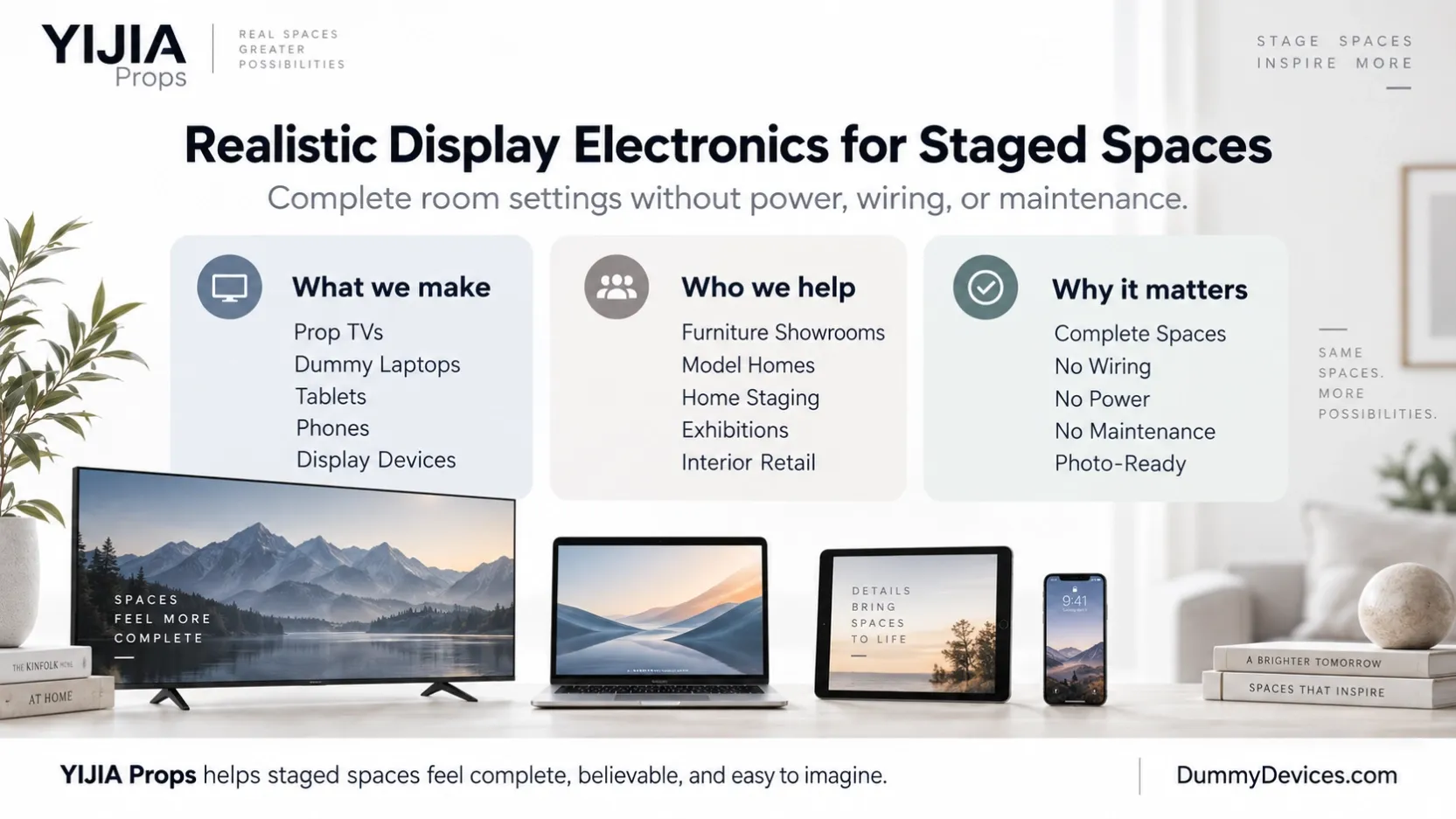
European Showroom Trends: Reusable Display Props, Material Compliance & Lower-Impact Staging
Sustainability in European furniture retail is moving beyond marketing language.
For showroom, visual merchandising and procurement teams, the more practical questions are increasingly about durability, reuse, material transparency, waste prevention and operational efficiency.
Can a display element be reused when a room setting changes?
Can it move from one store to another?
Can screen artwork be refreshed without replacing the entire product?
Does it require electricity, charging, software updates or electronic maintenance?
And does the supplier understand which material and product-compliance requirements actually apply to the project?
For furniture retailers operating multiple locations, these questions matter because sustainability and operational simplicity often point in the same direction.
The objective is not simply to buy something labelled “eco-friendly”.
It is to create showroom assets that can remain useful for longer and create less unnecessary complexity throughout their lifecycle.
Sustainability Starts With Reuse
One of the simplest ways to reduce showroom waste is to avoid replacing display elements unnecessarily.
Furniture showrooms change constantly.
Collections are refreshed. Room settings are redesigned. Seasonal campaigns change. Media consoles move. Home-office displays evolve. Stores are relocated, enlarged or remodelled.
If every change requires completely new display electronics, the staging system itself becomes wasteful.
A more practical approach is to specify display elements that can be:
reused across multiple room settings, relocated between stores, updated with new visual artwork, stored between campaigns and redeployed when required.
This follows the wider direction of European circular-economy policy, where waste prevention and keeping products and materials in use are prioritised over disposal.
For retailers, that also has a commercial advantage:
fewer replacements, fewer installation problems and fewer unnecessary purchasing decisions.
Non-Powered Display Electronics Can Reduce Operational Complexity
Using real consumer electronics for staging can introduce requirements that have little to do with the actual purpose of the showroom.
Power connections may be required.
Cables need to be managed.
Devices may need charging.
Screens and software can require configuration.
Equipment can fail or become outdated.
Security and handling may also become considerations.
For room settings where the purpose of the device is purely visual, a non-functional display prop offers a different model.
A non-powered Prop TV, laptop, tablet or phone is there to communicate scale, context and lifestyle — not to perform an electronic function.
That means there is no electricity consumed during normal display use, no software configuration and no need to keep the product technologically current.
This does not mean the product has “zero environmental impact.” Every physical product has materials, manufacturing, packaging and transport associated with it.
The more defensible sustainability argument is simpler:
Use the display asset for longer, reuse it more often and avoid unnecessary operational complexity.
RoHS: Understand the Scope Before Making the Claim
RoHS — the EU Restriction of Hazardous Substances Directive — restricts certain hazardous substances in electrical and electronic equipment.
The current framework covers ten restricted substances, including lead, mercury, cadmium, hexavalent chromium, certain flame retardants and several phthalates.
But there is an important distinction for showroom props.
RoHS applies to equipment that falls within the definition of electrical and electronic equipment. EU guidance defines this as equipment that depends on electric currents or electromagnetic fields to fulfil at least one intended function.
A completely non-powered display prop may therefore require a different regulatory assessment from a powered electronic device.
For procurement teams, the better question is not:
“Does every prop have a RoHS certificate?”
It is:
“Which regulations apply to this specific product, material composition and intended use?”
That is a much stronger procurement approach.
REACH and Material Transparency Also Matter
Even when a product is not electrical equipment, materials placed on the European market can still create obligations under other EU chemical frameworks.
Under REACH, articles containing certain Substances of Very High Concern can trigger information or notification obligations when relevant thresholds and conditions are met.
ECHA also operates the SCIP database for certain articles placed on the EU market containing Candidate List substances above 0.1% by weight.
For international buyers, this means material transparency matters.
Instead of relying on broad claims such as “100% safe”, “zero toxic materials” or “eco-friendly plastic”, procurement teams should request documentation appropriate to the actual product and project.
Depending on the product and requirement, that may include material declarations, supplier declarations, laboratory test reports or other project-specific compliance information.
The documentation should follow the product — not the marketing slogan.
Durable Materials Matter More Than Green Labels
ABS and other engineering plastics can be useful for showroom applications because of characteristics such as dimensional stability, impact resistance and suitability for repeat handling.
But calling a plastic automatically “sustainable” or “100% recyclable” oversimplifies the issue.
Actual recyclability depends on material formulation, additives, product construction, local collection systems and end-of-life processing.
For showroom procurement, a more useful question is:
Will this product survive repeated transport, installation, storage and showroom reconfiguration?
A durable prop that remains in service through repeated store changes can often be operationally preferable to a fragile display element that is constantly replaced.
From Sustainability to Store Standardization
The sustainability discussion becomes even more important for multi-store retailers.
Imagine one store buying a different display TV every time a room setting changes.
Now multiply that across 20, 50 or 100 locations.
Different sizes appear.
Different screen graphics are used.
Real electronics become obsolete.
Replacement decisions happen independently.
Old display units accumulate.
What looks like a small purchasing decision at store level becomes a network-wide operational problem.
A standardized display system changes that.
A retailer can define approved TV sizes, screen artwork, laptop or tablet formats, finishes and room-setting combinations once — and then reuse those standards across the store network.
This is where sustainability, brand consistency and operational efficiency begin to reinforce one another.
European Furniture Retail Is Moving Toward Lifecycle Thinking
The direction of European product policy increasingly emphasizes durability, circularity, repairability, material efficiency and better product information.
Under the EU Ecodesign for Sustainable Products Regulation, furniture is one of the priority product groups identified in the 2025–2030 working plan. Specific requirements are developed progressively rather than applying automatically to every product today. Environment
For furniture retailers and showroom teams, the wider message is still clear:
Think beyond the purchase price. Think about the lifecycle.
How long will the display asset remain usable?
How many store concepts can it support?
Can it be redeployed?
Can its visual content change?
Can the same specification be reordered later?
Can the retailer avoid unnecessary powered equipment where no electronic function is required?
These are increasingly useful procurement questions.
A Practical Procurement Checklist for European Showroom Projects
Before specifying display electronics for a European furniture or interior project, start with five questions:
Function: Does the display genuinely need to operate, or is its role purely visual?
Lifecycle: Can it be reused across future room settings, campaigns or locations?
Materials: What material and chemical information is available for the specific product?
Compliance: Which EU or national requirements actually apply to that product and intended use?
Repeatability: Can the same specification be reproduced later for additional stores or replacements?
For multi-location projects, one more question becomes essential:
Can this become a standard rather than another one-off purchase?
Where YIJIA Props Fits
YIJIA Props develops realistic, non-powered display electronics for furniture showrooms, model homes, commercial interiors and other staged environments.
The objective is not to replace functional electronics where technology is part of the customer experience.
It is to provide a simpler option where the purpose of the device is primarily visual.
For European projects, specification and documentation requirements should be reviewed against the exact product, destination market and project requirements before production.
This is particularly relevant for:
multi-store furniture showroom rollouts, visual merchandising programs, model-home staging, furniture collection launches, trade-show displays and hospitality or commercial interior mock-ups.
Sustainability Without Sacrificing the Room
A sustainable showroom still has to communicate.
The customer still needs to understand the scale of the media console.
The home-office desk still needs to feel believable.
The living room still needs visual balance.
The bedroom still needs to feel lived in.
The goal is therefore not to remove the details that complete the space.
It is to choose those details more intelligently.
Reuse them.
Standardize them.
Reduce unnecessary complexity.
Keep them working visually for longer.
That is a more practical definition of sustainable showroom staging.
Related Resources
CTA
Planning a European showroom or multi-store rollout?
Send us the destination market, intended application, product mix and expected rollout scale.
We can first define the most suitable display specification and identify which project documentation should be reviewed before moving to sample, pilot or rollout.