
Oct 12, 2026Case Studies
Vancouver Penthouse Staging: 85-Inch Prop TV Guide
A practical Vancouver penthouse staging guide covering large-format Prop TV selection, media wall planning, installation conditions, static artwork, handling, and project quotation requirements.
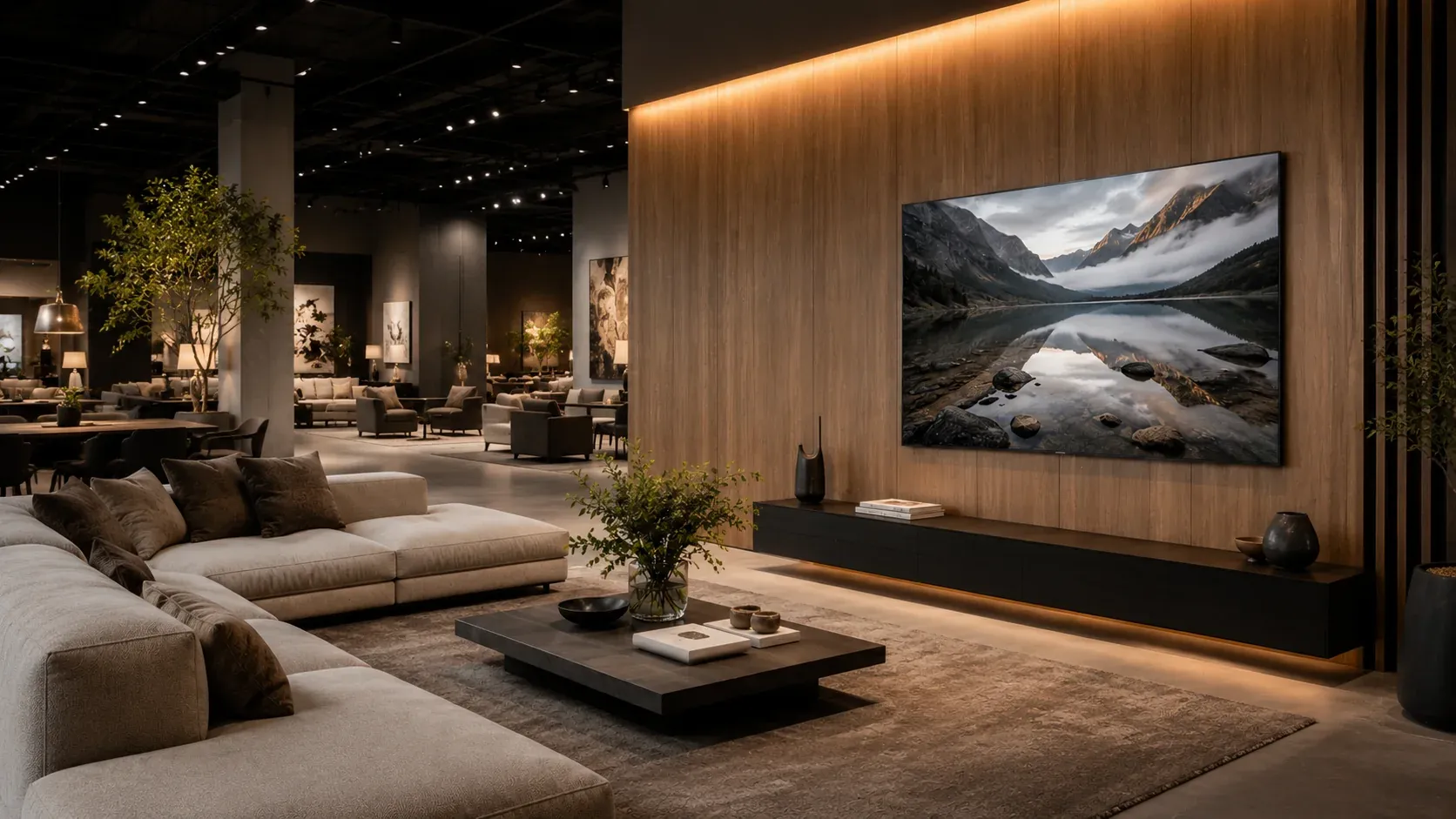
Vancouver Luxury Penthouse Staging: Large Prop TV & Media Wall Planning Guide
A luxury penthouse needs a carefully balanced interior presentation.
In a spacious living room, the relationship between the sofa, media cabinet, feature wall, and television can strongly influence how the finished space feels.
A smaller television may appear visually out of proportion. A large working television, however, may introduce electronic setup requirements that are unnecessary for a property marketing display.
For Vancouver developers, interior designers, and professional staging teams, a non-functional large-format Prop TV can be considered when the project needs a realistic television appearance rather than electronic functionality.
But selecting an 85-inch or 98-inch display requires more than choosing a screen size.
Wall construction, mounting compatibility, delivery access, static screen artwork, and installation responsibility must all be reviewed.
This guide explains how to plan a large-format media wall for luxury penthouse staging and prepare an effective procurement brief.
Planning note: Vancouver is used here as a regional project-planning context. The examples are illustrative and do not represent a verified YIJIA customer installation, property transaction, or independently measured sales result.
1. Why Large Media Walls Matter in Penthouse Staging
A premium penthouse may feature open-plan living spaces, substantial sectional sofas, custom cabinetry, and large architectural surfaces.
Within such a setting, the television can act as a familiar visual reference.
It helps visitors recognise the purpose of the media wall and understand how the furniture arrangement could function in everyday life.
However, the television should support the interior design.
It should not become more visually important than the architecture or furniture.
Before selecting a model, the design team should establish:
- The intended purpose of the living room
- The media cabinet or feature-wall dimensions
- The principal furniture arrangement
- Customer viewing positions
- Property photography requirements
- Whether electronic demonstration is necessary
- The intended installation configuration
A non-functional Prop TV is appropriate only when a static visual display meets the project's needs.
2. Choose Between 75-Inch, 85-Inch and 98-Inch Prop TVs
Large-format products should be compared against the actual interior rather than selected by screen size alone.
A useful preliminary framework is:
Display Size | Room-Planning Application | Primary Consideration |
|---|---|---|
75 inches | Premium living rooms and larger media cabinets | Is the display proportionate to the furniture? |
85 inches | Spacious penthouse living rooms and substantial media walls | Does the larger scale improve the composition? |
98 inches | Expansive feature walls and architectural-scale staging | Can the site safely accommodate the size and handling requirements? |
These are design considerations, not fixed room-width standards.
An 85-inch Prop TV may be a useful starting point for a spacious residential display.
A 98-inch model may deserve consideration if the feature wall and furniture arrangement are significantly larger.
In other settings, a 75-inch model may provide a more balanced result.
The decision must include the complete product dimensions, not just the nominal screen diagonal.
For an initial product review, explore our 85-inch Dummy TV for Model Homes and Luxury Living Rooms.
Confirm the actual size, weight, finish, display method, and available configuration before approving a model.
3. Assess the Media Wall Before Selecting a Mounting Method
The appearance of a premium feature wall does not establish its structural suitability for hanging a display product.
Luxury interiors may include decorative panels, stone veneers, timber finishes, partitions or other architectural treatments.
A visually substantial surface may conceal a supporting structure that is not intended for the proposed attachment.
The project team should identify:
Wall Construction
What structural backing or framing is present behind the visible finish?
Product Weight
What is the confirmed weight of the selected Prop TV and any mounting equipment?
Attachment Compatibility
Which attachment points and mounting arrangements are approved for the actual model?
Support Conditions
Can the supporting structure accommodate the intended installation loads and conditions?
Installation Responsibility
Who is qualified to assess and approve the installation?
Future Changes
Will the display need to be removed, relocated, or replaced after the marketing programme?
These questions should be resolved before installation.
A non-functional television may weigh less than some working televisions, but that fact alone does not establish that a wall can support it.
Do not mount a Prop TV directly onto a decorative wall or partition unless the specific installation has been assessed and approved by appropriately qualified personnel.
Any structural concerns should be resolved before the display is installed.
4. What If the Feature Wall Cannot Support the Selected Display?
A staging project may encounter a wall that is unsuitable for the proposed mounting arrangement.
The solution is not to assume that a lighter decorative product can be attached without further assessment.
Instead, the project team should review the display concept and the available installation options.
Consider a Suitable Tabletop Arrangement
A compatible display stand and supporting furniture may be an alternative, provided the arrangement is approved for the selected model and meets stability requirements.
Review an Independently Supported Display System
In some projects, a purpose-designed support structure may be considered.
Its design, stability, installation, and suitability must be confirmed by qualified professionals.
Reconsider the Display Size
An alternative size may suit the furniture arrangement while changing the project's handling and installation requirements.
However, a smaller model must still be properly supported.
Adjust the Room Composition
A media wall does not always need a television attached directly to its decorative surface.
Furniture placement, shelving, artwork, and the overall room layout may offer other ways to create a convincing residential setting.
The objective is to achieve the intended visual result without compromising installation safety.
5. Select Static Screen Artwork for Premium Interiors
YIJIA Prop TVs are non-functional physical display models.
They cannot play video, stream content, or operate smart applications.
Their screen presentation is static.
This can be suitable for residential staging where the intention is to maintain a controlled visual composition.
For a luxury penthouse, the artwork should complement the architecture and furniture.
Possible visual directions include landscape imagery, restrained abstract compositions, and other artwork appropriate for the property's design brief.
When reviewing artwork, consider:
Colour Harmony
Does the image coordinate with the furniture and wall finishes?
Visual Hierarchy
Does the screen complement the room, or does it compete with the architectural features?
Image Scale
Does the artwork look appropriate when reproduced on a large physical display?
Surface Reflections
How does the selected finish appear under the project's actual lighting?
Commercial Image Rights
Does the project have permission to reproduce the chosen artwork?
Custom static screen artwork may be discussed where supported by the selected model and project requirements.
Approval should cover the image, cropping, orientation and available surface finish before the relevant order is confirmed.
6. Review the Room for Professional Real Estate Photography
Property marketing photography presents different visual requirements from an ordinary showroom walk-through.
An 85-inch Prop TV may become a prominent feature in a wide-angle interior photograph.
Before photography, review the complete scene.
Overall Composition
The screen should appear naturally proportionate to the media cabinet, sofa arrangement, and wall.
Frame Alignment
The visible product should look correctly positioned within the approved display.
Screen Surface
Review reflections from windows, lighting and other surfaces.
A matte or reduced-reflection finish may help under some conditions, but no finish should be assumed to be completely reflection-free.
Artwork Selection
Avoid imagery that distracts from the furniture or conflicts with the intended interior style.
Physical Condition
Check the frame, corners, screen artwork, and visible surfaces for marks or damage.
Camera Position
Evaluate the scene from the actual photography viewpoints, not only from the centre of the room.
If an electronic screen is needed to display changing content during a marketing presentation, a functional device must be specified instead.
7. Build a Coordinated Penthouse Staging Prop Kit
A luxury residence may include spaces beyond the main living room.
For example, a project could include a home office, secondary bedroom, or lounge.
Not every room requires a television.
The display team may instead choose a small number of non-functional electronics to communicate the intended room purpose.
Room | Product to Consider | Visual Role |
|---|---|---|
Main living room | 75-inch, 85-inch or 98-inch Prop TV | Complete the large media-wall concept |
Home office | 13.3-inch Prop Laptop | Establish a realistic workspace |
Secondary study area | Prop Laptop or suitable AIO | Support the furniture's intended function |
Bedside setting | Optional non-functional phone or tablet | Add a restrained lifestyle detail |
Secondary living room | Smaller Prop TV if required | Match a different room scale |
These are illustrative product combinations, not a fixed package or a claim about an actual Vancouver installation.
A non-functional laptop or tablet cannot demonstrate software, smart-home automation, or electronic content.
It should be used as a visual staging element only.
The goal is to use the fewest suitable products needed to complete the design story.
8. Plan Delivery and Handling for a Vancouver Project
Large-format display props require careful logistical planning.
Even when a product is non-functional, its dimensions and construction may require special handling.
For a Vancouver penthouse or model suite project, confirm the complete delivery route before placing an order.
This includes:
Destination
The full receiving address and whether delivery is to a warehouse, construction site or completed building.
Building Access
Any loading-bay restrictions, lift dimensions, corridors, door openings and site access requirements.
Packaging
Actual carton dimensions, protective materials and unloading requirements.
Handling
The appropriate personnel and equipment for the product's size and weight.
Delivery Schedule
The required arrival date relative to installation and property photography.
Receiving Contact
The person responsible for checking the shipment and arranging its movement to the display location.
Cross-Border Requirements
If products are imported into Canada, confirm the applicable shipping terms, customs responsibilities, importer arrangements and taxes with the responsible parties.
No universal delivery time or landed cost should be assumed.
The quotation should reflect the actual destination, model mix, quantity and agreed commercial terms.
9. Build a Realistic Staging and Installation Schedule
A project schedule should work backwards from the date when the property must be ready for photography or viewings.
A practical sequence is:
Design Review
Confirm room layouts, media-wall proportions and the intended product sizes.
Product Selection
Shortlist the models that meet the visual requirements.
Technical Assessment
Review the proposed mounting or supporting arrangement and resolve any concerns.
Sample or Specification Approval
Confirm product appearance, screen artwork, dimensions, and approved configuration.
Procurement and Delivery
Finalise quantities, commercial arrangements, packing and project delivery requirements.
Receiving and Installation
Inspect the delivered products and arrange installation using the approved method.
Photography Readiness
Review alignment, surface condition, static imagery and the complete room composition.
The time required for these stages depends on the specific project.
A large-format installation should not be rushed simply to meet an arbitrary staging deadline.
10. Approve the Physical Model Before a Larger Purchase
For developers managing multiple luxury model suites, a representative product review can support consistent specification decisions.
A sample or approved reference should help confirm:
- Nominal and overall dimensions
- Physical appearance and finish
- Actual model weight
- Screen artwork
- Installation configuration
- Handling and packaging
- Furniture compatibility
- Applicable approval requirements
If the same display concept will be repeated in multiple units, record the approved model reference, photographs and any authorised alternatives.
Future supply arrangements and product availability should be confirmed for each project.
The purpose of a standardised specification is not to eliminate professional site assessment.
Every installation location still needs to be appropriate for the actual product.
11. Prepare a Large-Format Prop TV Procurement Brief
A useful project enquiry should include enough information for the supplier to understand the display requirement.
Requirement | Information to Provide |
|---|---|
Project type | Penthouse staging, luxury model suite or residential display |
Location | Vancouver or other Canadian project city |
Display model | Preferred 75-inch, 85-inch or 98-inch size |
Quantity | Number of units by size |
Room dimensions | Media-wall, furniture and relevant site dimensions |
Display method | Proposed tabletop or wall-mounted configuration |
Site conditions | Supporting surface details and any installation constraints |
Artwork | Preferred static screen image and finish |
Packaging | Building access and receiving requirements |
Schedule | Target arrival and installation dates |
Approval | Sample or specification review requirements |
Provide room photographs, elevations or drawings if available.
Where wall mounting is proposed, the supplier's product specifications can support the project team, but they do not replace assessment of the actual supporting structure by a qualified professional.
A clear procurement brief helps identify whether an available model can meet the design requirement and what information must be confirmed before an order.
12. Evaluate the Project Without Making Unsupported Sales Claims
A professional staging project can be assessed using outcomes that are directly observable.
These may include:
Design Approval
Did the finished display match the approved room concept?
Product Specification
Was the correct model, size, artwork, and finish supplied?
Installation Completion
Was the product installed using the approved method?
Delivery Performance
Did the shipment arrive according to the agreed project arrangements?
Photography Readiness
Was the final room prepared and approved for photography or property viewings?
Repeatability
Can the approved specification support other residential units or future staging projects?
Broader marketing results, such as property viewing volume, offer rates or sale timing, depend on many factors.
They should not be attributed to a single Prop TV without reliable supporting evidence and an appropriate evaluation method.
Frequently Asked Questions
Is an 85-inch Prop TV suitable for a luxury penthouse?
It may be suitable when the room proportions, furniture arrangement, site access and approved installation configuration support that size.
Is an 85-inch dummy TV safe to install on a decorative partition?
Do not assume so. The actual product, mounting equipment, and supporting structure must be assessed for the intended installation. A lighter product does not automatically make an unsuitable wall safe.
Should a penthouse use an 85-inch or 98-inch Prop TV?
Choose according to the complete media-wall design, furniture proportions, available space, and physical installation requirements. The larger model is not automatically the better choice.
Can a YIJIA Prop TV play video or display smart-home content?
No. These are non-functional display models with static screen artwork. Functional equipment is required for video, software, or interactive demonstrations.
Can the static screen image be customised?
Available customisation options depend on the model and production requirements. Confirm the artwork specifications and approval process before ordering.
Can a Vancouver developer combine several prop electronics in one project?
A mixed-product requirement can be discussed based on the requested models, quantities, destination, and project schedule.
Can these products be reused in future model suites?
Reuse may be possible when the product remains suitable for the new setting, and the handling and installation requirements are met.
What should we send YIJIA for a large-format project quotation?
Provide the preferred product sizes, quantities, room photographs or drawings, proposed installation method, site conditions, receiving location, and target date.
Plan Your Vancouver Penthouse Staging Project with YIJIA Props
A large media-wall display should be planned as part of the complete interior.
The right Prop TV size can support the proportions of a premium living room, while suitable static artwork helps the design team maintain a consistent visual presentation.
The product must also fit the project's real installation, access, and logistical requirements.
YIJIA Props supplies non-functional television models and other display electronics for furniture showrooms, luxury model homes and professional interior staging.
We can review available product sizes, visual configurations, sample requirements and project supply arrangements.
Request a Large-Format Prop TV Project Quote with your room drawings, preferred 85-inch or alternative size, estimated quantities, proposed display configuration and Vancouver delivery details.
The next step is to confirm the visual specification and the practical requirements of your project before purchase.