
Aug 1, 2026Prop Electronics
The 1:1 Standard: The Science of Silent Sales in Global Prop Electronics
Discover how YIJIA Props defines the 1:1 Standard for professional prop electronics through realistic proportions, considered CMF, commercial usability and coordinated project supply.
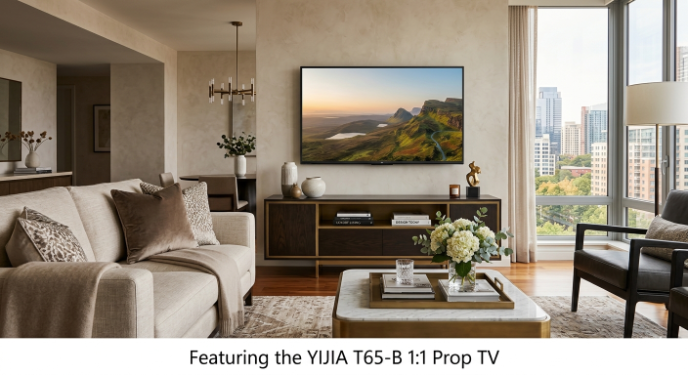
The Science of Silent Sales:
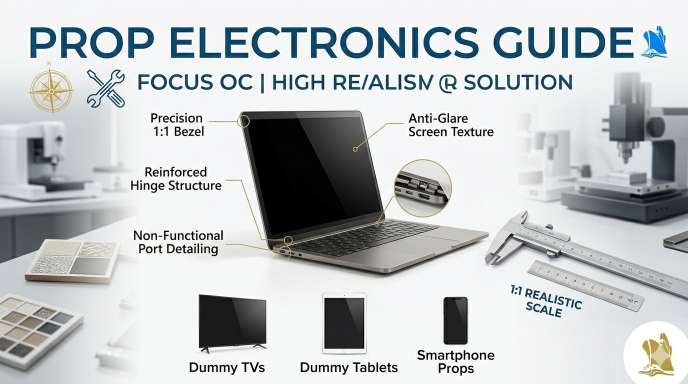
Defining the 1:1 Standard in Global Prop Electronics
A professional display prop succeeds when it feels naturally integrated into the surrounding space.
In a furniture showroom, real estate model home or commercial interior, a television, laptop or smartphone is rarely the main product being sold. Yet its dimensions, finish and placement can influence how customers perceive the furniture, architecture and overall quality of the environment.
A television with awkward proportions can weaken a carefully designed media wall. A toy-like laptop can make an executive desk feel artificial. A phone or tablet with an unconvincing finish can interrupt an otherwise refined lifestyle scene.
This is why YIJIA Props does not approach prop electronics as generic decorative shells.
We treat them as visual components within a larger spatial system.
The YIJIA 1:1 Standard defines how professional prop electronics should reproduce the recognizable scale, proportions and material presence of modern devices while avoiding the maintenance requirements associated with functional electronics.
The standard is built around five principles:
- Convincing physical proportions
- Appropriate color, material and finish
- Realistic structural and interface details
- Practical performance in commercial display environments
- Consistent project coordination from product selection to delivery
Together, these principles help furniture brands, property developers, interior designers and visual merchandising teams create spaces that feel complete, intentional and commercially persuasive.
Chapter 1: The Dignity of Physical Dimensions
Why 1:1 Scale Matters
Interior design is a discipline of proportion.
Furniture, wall systems, architectural openings and decorative objects are arranged according to their relationships with one another. Even when visitors do not consciously measure each object, the human eye remains highly sensitive to visual imbalance.
This sensitivity is particularly strong with consumer electronics.
Most people see televisions, laptops, phones and tablets every day. They develop an intuitive understanding of what these objects should look like. When a display prop has visibly incorrect proportions, visitors may sense that something is wrong before they can identify the cause.
The result may be subtle, but commercially important:
- The furniture can appear less premium.
- The room may feel unfinished.
- The display can look temporary.
- The design concept may lose credibility.
- The physical environment may not match the quality of the original rendering.
The 1:1 Standard begins with the belief that approximate resemblance is not enough for professional staging.
1. The Trap of Visual Distortion
Many inexpensive display props are created from generic molds intended to serve multiple products or applications.
This approach may reduce development complexity, but it can also produce visible inconsistencies such as:
- Incorrect screen proportions
- Oversized bezels
- Unnatural body thickness
- Simplified corners
- Inaccurate stands
- Distorted keyboard layouts
- Toy-like interfaces
- Poor relationships between the frame and the display area
These issues become more noticeable when the prop is positioned beside custom furniture or architectural surfaces.
A television mounted on a precisely built feature wall must relate naturally to the surrounding cabinetry. A laptop placed on a designer desk must maintain a believable relationship between its screen, keyboard and hinge. A tablet placed on a kitchen counter should feel like part of a modern connected-home environment rather than an unrelated accessory.
YIJIA develops professional product electronics around the recognizable dimensions, proportions and visual characteristics of real device categories.
Particular attention is given to:
- Screen geometry
- Body thickness
- Corner treatment
- Hinge structure
- Keyboard layout
- Stand design
- Port positioning
- Frame-to-screen relationships
The objective is to create products that remain visually convincing when placed beside premium furniture, custom cabinetry and carefully planned architectural surfaces.
For living rooms, furniture displays and model homes, explore professional 1:1 prop TVs for showroom and model-home staging.
For home offices and contemporary workspaces, discover realistic prop laptops for premium workspace staging.
2. Preserving the Designer’s Visual Intent
Many interior projects begin as highly detailed digital renderings.
These renderings communicate:
- Product scale
- Room balance
- Material relationships
- Lighting direction
- Lifestyle positioning
- Intended customer experience
When the completed physical environment uses accessories that differ noticeably from the rendering, the connection between concept and execution begins to weaken.
A professional prop should help preserve the designer’s original intention.
It should support the room rather than call attention to itself.
This is especially important in:
- Luxury property developments
- Flagship furniture showrooms
- Branded retail environments
- Commercial interior photography
- Exhibition installations
- Multi-location display programs
The role of the prop is not to dominate the scene. Its role is to make the scene more believable.
3. The Micro-Expressions of Interfaces
Modern photography makes small details increasingly visible.
High-resolution images, close-up shots and social-media content can reveal elements that might previously have gone unnoticed.
A painted rectangle cannot create the same depth as a molded port. A flat printed keyboard cannot respond to light like a structured keyboard surface. An overly simplified hinge can make an otherwise convincing laptop feel artificial.
Professional prop electronics may incorporate details such as:
- Recessed connection ports
- Speaker openings
- Camera details
- Keyboard separations
- Button positioning
- Hinge geometry
- Screen-to-body transitions
- Stand and base structures
These are the micro-expressions of industrial design.
Individually, they may appear minor. Together, they strongly influence whether the product feels credible.
4. Light, Shadow and Physical Depth
Real physical details interact naturally with light.
A recessed interface creates a shadow. A rounded edge catches a highlight. A keyboard separation creates subtle contrast. A layered frame gives the eye information about depth and structure.
These effects are difficult to reproduce with stickers, printed lines or flat decorative surfaces.
Physical depth becomes particularly valuable in:
- Catalog photography
- Real estate marketing
- Interior-design presentations
- Advertising campaigns
- Film and television production
- High-resolution online content
The 1:1 Standard, therefore, concerns more than measurement.
It also considers how a product behaves under real showroom and studio lighting.
Chapter 2: The CMF Dialogue
Color, Material and Finish
CMF refers to:
- Color
- Material
- Finish
In industrial design, CMF helps determine whether a product feels technical, elegant, warm, premium, minimal or outdated.
For prop electronics, CMF is often the difference between a convincing professional display model and an obvious imitation.
A product may have approximately the correct shape, but still feel wrong because its plastic is too glossy, its screen is too flat, its color is inconsistent or its edges reflect light unnaturally.
The YIJIA 1:1 Standard treats CMF as part of the product’s spatial performance.
1. Reducing the “Plastic Look”
Low-quality display models may use materials or surface treatments that create:
- Uneven textures
- Excessive gloss
- Dull colors
- Visible molding marks
- Weak corners
- Inconsistent surfaces
- Unpleasant odors
- Premature wear during normal handling
YIJIA selects materials according to the visual, structural and commercial requirements of professional display environments.
The material system is intended to support:
- A cleaner surface appearance
- More consistent color
- Appropriate structural stability
- Resistance to normal showroom handling
- More convincing interaction with commercial lighting
- Continued indoor display use under suitable conditions
Material selection may vary according to product category, structure, finish and intended application.
2. Different Products Require Different Surface Behaviors
A television, laptop, tablet and phone should not all use the same generic finish.
Each category has its own visual language.
A professional prop TV may require a controlled dark screen and a restrained frame. A laptop may need a refined shell, a believable keyboard surface, and a realistic hinge. A smartphone may depend on precise edge treatment and carefully balanced reflections.
The 1:1 Standard, therefore, considers:
- Surface gloss
- Matte level
- Texture
- Reflectivity
- Edge definition
- Color consistency
- Visual depth
- Relationship between different materials
For executive offices and premium commercial workspaces, all-in-one prop desktops for executive office displays provide a stronger desktop centerpiece.
For bedside tables, coffee tables and smaller lifestyle scenes, flagship prop phones for realistic lifestyle details add the finishing details that make a space feel naturally occupied.
3. The Beauty of the Dark Screen
A powered-off electronic screen is not simply a flat black rectangle.
It still has:
- Depth
- Controlled reflectivity
- Subtle tonal variation
- A relationship with the surrounding light
- A distinct boundary between the screen and frame
An excessively glossy display surface may create distracting reflections. An overly dull surface may appear like a painted board or printed plastic.
YIJIA develops controlled screen appearances intended to support professional display and photography.
Depending on the product and project requirements, the screen direction may include:
- A neutral dark appearance
- A low-reflection finish
- A lifestyle image
- A property-development visual
- A brand-specific graphic
- A campaign image
- An interior-compatible artwork concept
The screen should support the surrounding space rather than compete with it.
4. Photography-Oriented Presentation
A professional staging prop must work for both physical visitors and cameras.
Appropriate surface treatment can help:
- Reduce distracting glare
- Improve consistency between viewing angles
- Preserve the intended visual hierarchy
- Avoid software notifications
- Eliminate changing screen content
- Support more controlled photography
Unlike a functional screen, a display-only screen does not change brightness, display alerts or introduce unexpected interfaces during a photoshoot.
This gives designers and creative teams greater control over the final composition.
5. Color Stability and Display Conditions
Surface treatments and material choices are developed to support a consistent appearance during normal indoor showroom use.
However, long-term appearance can be influenced by factors such as:
- Direct sunlight
- Heat
- Humidity
- Cleaning chemicals
- Storage conditions
- Installation environment
- Frequency of handling
Project-specific requirements should therefore be discussed before production, particularly for products exposed to unusual environmental conditions.
The most appropriate product and finish depend on the application.
Chapter 3: The Commercial Logic of Display-Only Electronics
Why Cheap or Broken Real Electronics May Cost More
Buyers sometimes ask:
Why not purchase used or broken electronics and use them as display props?
At first, this can appear to be a convenient and inexpensive solution.
However, the purchase price is only one part of the total commercial cost.
Professional display environments must also consider:
- Transportation
- Installation
- Maintenance
- Security
- Visual consistency
- Replacement
- Store-to-store coordination
- Photography requirements
- Long-term handling
A functional or broken electronic device may be inexpensive to acquire, but complicated to manage.
1. Weight and Installation Complexity
Working televisions and other functional electronics contain glass panels, internal boards, power components and structural parts that add weight and handling complexity.
They may require:
- Stronger mounting systems
- More careful transportation
- Additional installation labor
- Greater storage protection
- Specialist handling
- More complex repositioning
Professional prop electronics are designed with display use in mind.
Depending on the model and configuration, they may offer advantages such as:
- Easier handling
- Simpler repositioning
- Reduced installation requirements
- Less demanding mounting conditions
- More efficient storage
- Easier movement between showroom displays
Exact dimensions, weight and installation requirements should always be confirmed for the selected model.
2. The Maintenance Trap
A broken real television or computer is not automatically a stable display product.
It may still contain:
- Fragile internal components
- Loose panels
- Heavy glass
- Damaged structures
- Aging wiring
- Sharp internal or external parts
- Inconsistent cosmetic condition
Working devices also create additional management requirements, including:
- Power connections
- Remote controls
- Software updates
- Network access
- Screen-content control
- Battery charging
- Technical troubleshooting
Display-only electronics avoid many of these recurring operational tasks.
3. Transport and Handling Risk
Functional electronics contain internal components that may remain vulnerable during transportation even when they are no longer operational.
Professional display props can be designed with simpler internal structures and packaging suited to commercial handling.
This may help reduce common transportation and installation difficulties, but appropriate packaging and correct freight procedures remain necessary.
Every physical product should still be handled according to its structure, size and intended use.
4. Operational Efficiency
Display-only electronics require no:
- Power supply
- Charging
- Software updates
- Network access
- Remote-control management
- Live screen-content management
For businesses operating multiple showrooms or model homes, removing these recurring requirements may reduce:
- Staff time
- Technical coordination
- Cable management
- Device maintenance
- Content management
- Replacement complexity
The level of operational benefit depends on the number of locations, display duration, local labor costs and the type of functional electronics being replaced.
5. Visual Standardization Across Multiple Locations
Real or used electronics often vary between units.
A multi-store furniture group may receive products with different:
- Bezel designs
- Stand shapes
- Body colors
- Screen treatments
- Dimensions
- Cosmetic condition
- Installation requirements
A coordinated prop-electronics program can help standardize:
- Product categories
- Device sizes
- Screen graphics
- Color direction
- Installation methods
- Packaging
- Store allocation
- Repeat-order specifications
This makes visual-merchandising programs easier to reproduce across cities, regions or countries.
6. Installation and Safety Considerations
Because display-only props contain no active electronic system, they avoid many of the operational requirements associated with powered devices.
However, all products must still be installed, mounted and handled appropriately.
Each project should consider:
- Wall condition
- Mounting hardware
- Product placement
- Public access
- Furniture stability
- Local safety requirements
- Maintenance access
- Movement during daily operations
A lightweight or non-functional product should not be interpreted as requiring no installation planning.
Chapter 4: Global Supply-Chain Integrity
From Product Development to Final Delivery
A convincing product is only part of a successful B2B project.
Professional buyers also need confidence that:
- Samples reflect the intended direction
- Production specifications remain consistent
- Packaging protects vulnerable areas
- Quantities are correctly coordinated
- Documentation matches project requirements
- Repeat orders can follow the agreed specifications
- Products reach the intended destination in suitable condition
The 1:1 Standard, therefore, extends beyond product appearance.
It includes the coordination required to use prop electronics in real commercial projects.
1. Production Consistency
YIJIA focuses on maintaining agreed specifications across samples, production orders and repeat projects.
Quality-control priorities may include:
- Dimensional consistency
- Surface appearance
- Color matching
- Screen presentation
- Structural condition
- Assembly quality
- Packaging condition
- Order accuracy
Project standards should be confirmed before production, especially for customized items and multi-location programs.
2. Protective Packaging
Prop electronics have different vulnerable areas depending on their structure.
Packaging may need to protect:
- Screens
- Corners
- Hinges
- Frames
- Stands
- Surface finishes
- Accessories
- Mounting components
YIJIA uses protective packaging selected according to the size, structure and shipping requirements of each product.
Packaging may include:
- Heavy-duty corrugated cartons
- EPE protective materials
- Corner protection
- Screen protection
- Internal positioning supports
- Additional reinforcement for larger products
The packaging objective is to reduce unnecessary movement and impact during normal freight handling.
Packaging arrangements can be adapted for samples, bulk orders, mixed-product shipments and long-distance delivery.
3. Packaging Review
Packaging arrangements are reviewed according to product structure and expected transportation conditions.
The appropriate solution may depend on:
- Product size
- Order quantity
- Transport method
- Delivery distance
- Warehouse handling
- Final installation requirements
- Whether the shipment contains mixed products
Where necessary, project-specific packaging measures can be discussed before shipment.
Testing claims should only be used when corresponding records exist for the relevant product and packaging configuration.
4. Multi-Product and Multi-Location Coordination
Professional projects may require more than one type of electronic prop.
A furniture group, model-home project or exhibition program may combine:
- Prop TVs
- Prop laptops
- AIO desktop models
- Prop tablets
- Prop phones
- Prop gaming consoles
Project coordination may include:
- Mixed-product planning
- Size allocation
- Store-by-store quantities
- Screen-image preparation
- Sample approval
- Carton identification
- Regional warehouse delivery
- Repeat-order records
The objective is to treat prop electronics as a coordinated staging system rather than a collection of unrelated accessories.
5. Documentation and Market Requirements
Material declarations and compliance-related documentation may be available depending on the product, order requirements and destination market.
Buyers should confirm the required documentation before placing an order, particularly for:
- European projects
- North American projects
- Government procurement
- Large corporate buyers
- Regulated commercial environments
- Special importing requirements
Compliance should be evaluated for the specific product and shipment rather than presented as a universal claim covering every model and destination.
Chapter 5: One Standard, Six Spatial Systems
The 1:1 Standard applies across the complete Dummy Devices™ product ecosystem.
Each product category has its own visual function and supports a different type of commercial environment.
1. Professional Prop TVs
Core spaces
- Living rooms
- Furniture showrooms
- Model homes
- Media walls
- Luxury residential interiors
- Entertainment areas
A prop TV often acts as the primary visual anchor of the room.
Its scale and placement establish the relationship between sofas, media consoles, walls and surrounding accessories.
A well-selected prop TV can help customers understand the intended use of the space without requiring a working screen, visible wiring or ongoing device management.
2. Professional Prop Laptops
Core spaces
- Home offices
- Flexible workspaces
- Office furniture displays
- Study rooms
- Executive desks
- Co-working environments
A laptop communicates productivity, mobility and contemporary professional life.
It can transform an empty desk into a believable working environment while allowing designers to control positioning, screen appearance and visual consistency.
3. All-in-One Prop Desktops
Core spaces
- Executive offices
- Commercial workspaces
- Reception areas
- Large office desks
- Premium office furniture showrooms
- Meeting environments
An AIO desktop provides a stronger and more permanent visual centerpiece than a portable laptop.
It is particularly suitable for spaces where the furniture needs to communicate authority, structure and professional use.
4. Smart Home Prop Tablets
Core spaces
- Smart homes
- Kitchens
- Living areas
- Meeting tables
- Reception counters
- Residential sales displays
A tablet can suggest control, connectivity and intelligent living without requiring an operational smart-home system.
It works naturally beside televisions, kitchen surfaces, home-office furniture and other modern lifestyle products.
5. Next-Generation Prop Game Consoles
Core spaces
- Media rooms
- Entertainment areas
- Youth bedrooms
- Gaming desks
- Family living spaces
- Creative lifestyle displays
A game-console prop transforms an empty media unit into a believable entertainment environment.
When paired with a professional prop TV, it helps communicate how the room is intended to support relaxation, family entertainment or gaming.
6. Flagship Prop Phones
Core spaces
- Bedside tables
- Coffee tables
- Home-office desks
- Reception counters
- Lifestyle photography
- Hospitality interiors
A phone is a small object with significant emotional influence.
It suggests recent human activity and helps a professionally arranged environment feel naturally inhabited rather than artificially staged.
Chapter 6: The YIJIA Expert Promise
Not Just a Product, but a Display Solution
YIJIA Props does not define professional prop electronics through exaggerated specifications or universal claims.
We define them by how effectively they perform inside real commercial spaces.
A successful prop should:
- Maintain convincing proportions
- Support the designer’s visual concept
- Look appropriate under commercial lighting
- Reduce unnecessary operational work
- Remain consistent within a coordinated project
- Arrive properly protected for its intended use
The purpose of the YIJIA 1:1 Standard is not to claim perfection.
It is to establish a more disciplined, professional and commercially useful approach to display-only electronics.
The YIJIA Service Ecosystem
Product Selection
We help buyers identify suitable product categories, sizes and configurations according to the intended space.
Specification Confirmation
Project details such as dimensions, colors, screen graphics, installation methods and quantities can be confirmed before production.
Sample Coordination
Samples may be arranged for buyers who need to evaluate appearance, structure or project suitability before a larger order.
Project-Specific Development
Custom development can be evaluated for buyers requiring particular:
- Dimensions
- Colors
- Screen graphics
- Surface treatments
- Product combinations
- Installation requirements
- Packaging arrangements
Feasibility and production requirements depend on the complexity and quantity of the project.
Bulk-Order Coordination
Mixed products, multiple sizes and store-specific quantities can be organized for showroom groups, property developments and exhibition projects.
Packaging Planning
Packaging can be reviewed according to product size, transport method, order quantity and delivery requirements.
International Shipping Support
Shipping documentation, carton information and logistics coordination can be prepared according to the agreed project scope.
Repeat-Order Management
Agreed specifications can be recorded to support more consistent repeat orders and multi-stage rollout programs.
Frequently Asked Questions
What does “1:1 Standard” mean?
The YIJIA 1:1 Standard refers to a professional approach to prop electronics based on recognizable dimensions, balanced proportions, appropriate materials and realistic visual details.
It does not mean that every product is a replica of a specific branded device.
The objective is to create visually convincing display products suited to professional staging environments.
Are YIJIA's prop electronics functional?
No. They are primarily developed as non-functional display products for staging, showroom presentation, exhibitions and creative production.
Specific configurations should be confirmed before ordering.
Why use prop electronics instead of real electronics?
Prop electronics can help reduce requirements related to power, charging, software, screen management, security and repeated showroom repositioning.
Their suitability depends on whether the project needs a visual presentation or actual electronic functionality.
Who uses professional prop electronics?
Typical users include:
- Furniture brands
- Furniture retailers
- Property developers
- Interior designers
- Home-staging professionals
- Visual-merchandising teams
- Exhibition contractors
- Film and advertising productions
Can different product categories be ordered together?
Mixed-product orders can be discussed for projects requiring coordinated televisions, laptops, tablets, phones, desktop models and gaming consoles.
Availability and packaging arrangements depend on the selected products and quantities.
Can screen images and colors be customized?
Customization may be available depending on the product, order quantity and project requirements.
The requested direction should be confirmed before production.
Can I request a sample?
Sample arrangements can be discussed according to product availability, destination and project needs.
What information is needed for a quotation?
A useful quotation request should include:
- Product category
- Preferred size
- Required quantity
- Installation method
- Customization requirements
- Intended application
- Delivery country or city
Conclusion: Choose the Standard Behind the Scenes
In a visual market, every detail communicates.
The television on the wall, the laptop on the desk and the phone beside the bed may remain silent, but together they help customers understand how the space is intended to feel.
YIJIA Props develops professional display electronics around proportion, material appearance, practical installation and coordinated project supply.
We are not simply creating electronic products without functions.
We are creating visual tools that help furniture, interiors and property developments tell more convincing stories.
That is the purpose of the 1:1 Standard:
Not to make the prop the center of attention, but to make the entire space more believable.
Elevate Your Display Today
Planning a furniture showroom, model home, commercial interior, exhibition or multi-location display program?
Send us:
- Required product categories
- Preferred sizes
- Quantities
- Installation methods
- Customization requirements
- Delivery country or city
Primary CTA: Get a Bulk Quote
Secondary CTA: Request a Sample
Optional CTA: Explore the 1:1 Precision Collection
Internal-Link Implementation Links from This Mother Article
Prop TV
Prop Laptop
AIO Desktop
Prop Tablet
Prop Phone
Game Console
Required Backlink from Every Child Article
Each of the six child articles should link back to this mother article within the first section or the first 20% of the main content.
Recommended anchor-text variations:
- The 1:1 Standard for professional prop electronics
- The YIJIA 1:1 Precision Standard
- The principles behind realistic 1:1 prop electronics
- The global standard for professional display props
- The 1:1 Precision Guide
- YIJIA’s approach to non-functional realism
Do not use the same backlink anchor in all six articles. Natural variations help clarify context without making the linking pattern appear mechanical.
Website Claim Standard
Avoid publishing claims such as:
- Exact dimensional tolerances without inspection records
- Completely accurate
- Perfect replica
- Zero breakage
- Zero risk
- Guaranteed never to fade
- Lifetime guarantee
- Fully compliant in every market
- Patented packaging without documentation
- Passes a specific test without a report
- Saves a specific amount without calculations
- Can be installed by anyone
- Suitable for every project
Prefer expressions such as:
- Designed around realistic proportions
- Developed for professional display use
- Helps reduce handling complexity
- Supports more consistent showroom presentation
- May reduce maintenance requirements
- Documentation may be available depending on the product
- Subject to model and project requirements
- Confirm specifications before ordering
- Suitable for a range of professional staging applications