
Buying Guides
Dummy TV RFQ Template for Furniture Showroom Buyers | DummyDevices
Prepare a clear dummy TV RFQ for furniture showrooms. Compare sizes, mounting, quantities, packaging, samples, and delivery requirements before ordering.
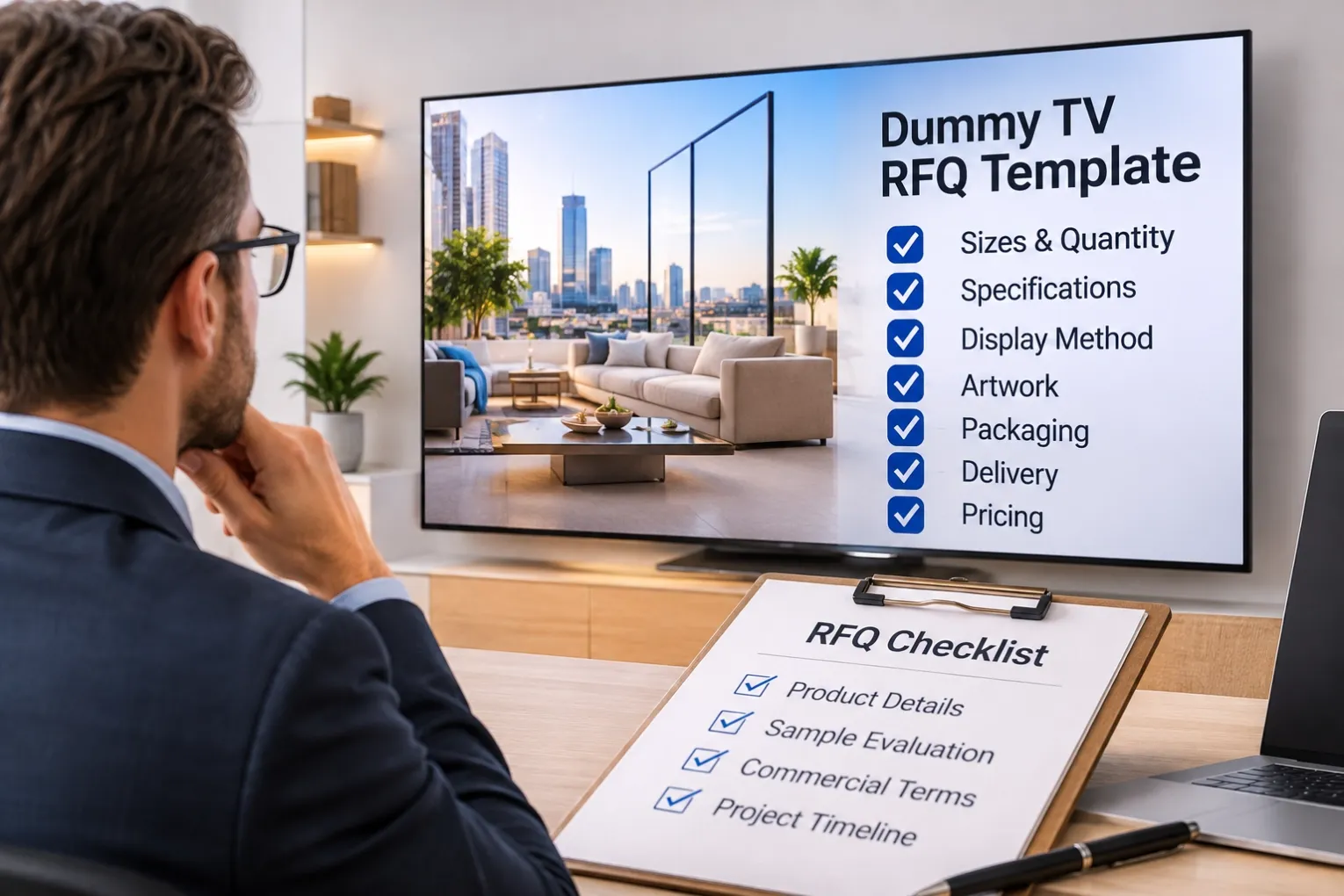
Dummy TV RFQ Template for Furniture Showroom Buyers: What to Include Before Requesting a Quote
A practical procurement checklist for furniture retailers, visual merchandising teams, and multi-store display projects.
Buying dummy TVs for one room setting is relatively straightforward. Sourcing them for an entire furniture showroom—or a network of stores—requires a more structured approach.
A quotation that only asks for "50 dummy televisions" leaves several critical questions unanswered.
Which sizes are needed? Will the units be wall-mounted or displayed on media cabinets? Are the screen graphics standardized? Will the shipment go to one distribution center or several stores?
Without clear specifications, two supplier quotations may look comparable while covering different products, accessories, packaging, or delivery responsibilities.
A well-prepared request for quotation (RFQ) helps procurement, visual merchandising and store planning teams compare suppliers on a consistent basis.
This guide explains what to include.
1. Start With the Display Purpose
Before selecting a TV size, identify where and how the prop will be used.
Common applications include:
- Furniture showrooms and room settings
- Residential model homes and show apartments
- Home staging and furniture rental projects
- Retail window and exhibition displays
- Multi-store furniture retail rollouts
A non-functional prop TV is intended to complete the visual environment. It does not provide television broadcasts, video playback, apps, or interactive functionality.
If your display requires moving content or a working screen, a functional television or commercial display may be more appropriate.
Defining the intended use at the beginning prevents costly misunderstandings.
2. Specify the Required TV Sizes
Avoid requesting a single generic price for "dummy TVs."
Instead, list the sizes required for each room type or project.
For example:
Display Location | Suggested Size to Evaluate | Quantity |
|---|---|---|
Compact living room | 50 or 55 inches | To confirm |
Standard living room | 65 inches | To confirm |
Large living room | 75 inches | To confirm |
Flagship media wall | 85 inches or larger | To confirm |
These are planning examples, not mandatory size standards. Final selection should follow furniture dimensions, sightlines, and room composition.
3. Confirm the Physical Specifications
The diagonal screen size alone is not enough to approve a prop TV.
Ask suppliers to confirm:
- Overall product width and height
- Depth and frame profile
- Product weight
- Frame material and finish
- Screen appearance and surface treatment
- Tabletop stand availability
- Wall-mounting requirements
- Applicable mounting-hole pattern
- Product photographs or technical drawings
Do not assume that two products with the same advertised screen size have identical outer dimensions or mounting hardware.
For furniture manufacturers and visual merchandising teams, these differences can affect the appearance of media cabinets, wall panels and shelving.
4. Define the Display Method
Every RFQ should specify how the dummy TV will be positioned.
Tabletop display
The prop sits on a media cabinet, entertainment unit or display shelf.
Confirm whether the required stand is included, supplied separately or available as an option.
Wall-mounted display
The prop is installed as part of a media wall or room setting.
Confirm mounting-hole dimensions, compatible hardware, installation requirements and wall suitability before approval.
Temporary staging
The product may be moved between rooms or projects.
In this case, packaging, handling instructions and repeated setup become more important.
The supplier should understand the application before finalizing the configuration.
5. Clarify Screen Artwork and Appearance
A dummy TV is part of the room's visual composition.
For some showroom concepts, a dark screen creates a quiet, minimal appearance.
Other projects may benefit from printed lifestyle imagery or selected display graphics, where supported by the product configuration.
Specify:
- Black-screen or graphic-screen preference
- Approved image or artwork
- Artwork dimensions and resolution requirements
- Whether the artwork is fixed or replaceable
- Whether different locations require different artwork
- The approval process for custom graphics
For multi-store projects, use a consistent artwork reference and version number.
This helps prevent different stores from receiving inconsistent visual presentations.
6. Request Sample Evaluation Before Bulk Supply
A sample should validate more than product appearance.
Ask the supplier to confirm which details can be reviewed before production or bulk dispatch.
A practical evaluation should cover:
Visual approval: Does the frame, screen appearance, and finish match the showroom concept?
Dimensional approval: Does the unit fit the intended furniture or media wall?
Placement approval: Is the proposed tabletop or mounting method suitable?
Packaging approval: Is the product protected appropriately for the planned transport method?
Specification record: Can the approved version be clearly identified for future orders?
The sample stage should end with a documented approval, not just an informal comment that the product looks acceptable.
7. Provide Quantities by Size and Location
For a multi-store rollout, a single total quantity is rarely enough.
Prepare a simple matrix.
Product | Pilot Store | Store Group A | Store Group B | Total |
|---|---|---|---|---|
55-inch Prop TV | 2 | 20 | 30 | 52 |
65-inch Prop TV | 3 | 40 | 60 | 103 |
75-inch Prop TV | 1 | 15 | 25 | 41 |
Illustrative quantities only—not a record of an actual customer order.
This structure helps identify the product mix, purchase phases and possible replenishment requirements.
It also makes later changes easier to control.
8. Include Packaging Requirements
Packaging affects receiving, damage reporting, storage, and distribution.
Ask for:
- Individual or combined carton packaging
- Carton dimensions
- Gross weight per carton
- Packaging protection method
- Carton identification labels
- Product and quantity references
- Palletization information where applicable
- Handling instructions
For a large retail network, decide whether products should be organized by SKU, room type, warehouse, or individual store.
The best packaging method depends on the receiving operation, not simply the lowest initial packing cost.
9. Define the Delivery Destination
The quotation should identify where the products must arrive.
Possible destinations include a central distribution center, regional warehouse, furniture showroom, staging warehouse, or appointed freight forwarder.
Provide the destination country and postal code where available.
Also clarify the preferred delivery model, target arrival window and requested trade terms.
When comparing international suppliers, distinguish the product price from freight, customs clearance, import duties, taxes and any local distribution costs.
Ask each supplier to state exactly which costs and responsibilities are included.
10. Request a Clear Commercial Breakdown
A useful B2B quotation should make the commercial terms easy to compare.
Request:
- Unit price by size and configuration
- Sample price and shipping
- Quantity-based pricing, if available
- Minimum order requirements
- Customization charges, where applicable
- Packaging charges, if separate
- Production lead time
- Estimated shipping arrangement
- Payment terms
- Quotation validity
- Warranty or defect-handling policy
Avoid choosing suppliers solely by the lowest advertised unit price.
The relevant comparison is the approved product configuration and the total cost of getting the required displays ready for use.
11. Confirm Repeat-Order Requirements
A furniture retailer may use a display standard across several seasons or new-store openings.
The initial RFQ should address how approved specifications will be preserved.
Useful questions include:
- Can the approved product reference be retained?
- How will future specification changes be communicated?
- Can an approved screen graphic be referenced for repeat orders?
- How are replacement units identified?
- Can products be supplied in several shipment phases?
- What information should the buyer provide when reordering?
The objective is to reduce the need to restart product selection every time another store opens.
12. Use This Ready-to-Send Dummy TV RFQ Template
Subject: RFQ – Dummy TVs for Furniture Showroom Display Project
Dear Supplier,
We are sourcing non-functional dummy TVs for a furniture showroom/model home / multi-store display project.
Please provide a quotation based on the following information:
Project details
- Company:
- Project type:
- Destination country:
- Number of stores or display locations:
- Target delivery date:
Product requirements
- Required TV sizes:
- Quantity by size:
- Preferred frame finish:
- Screen artwork requirement:
- Tabletop or wall-mounted display:
- Required accessories:
- Any custom specifications:
Commercial and logistics requirements
- Sample availability and cost:
- Unit prices by size:
- Quantity discounts, if available:
- Packaging specifications:
- Production lead time:
- Shipping options and trade terms:
- Payment terms:
- Repeat-order support:
Please also share relevant product photographs, dimension drawings, and packaging information for evaluation.
We look forward to reviewing your proposal.
Best regards,
[Name / Company]
From RFQ to an Approved Showroom Display Standard
A strong purchasing process does not end when the quotation is received.
The most effective next step is to compare the proposed products against the real showroom application.
For a single model home, that may involve approving a small combination of TV sizes.
For a furniture chain, the process may involve sample approval, a pilot store, regional allocation, and repeat replenishment.
The underlying principle is the same: confirm the visual specification before scaling the order.
At DummyDevices by YIJIA Props, we support B2B buyers evaluating non-functional prop TVs and display electronics for furniture showrooms, model homes and multi-location display projects.
Our focus is on helping buyers define a practical, repeatable display specification rather than selecting products by screen size alone.
Request a Dummy TV Project Quotation
Planning a new showroom, staging project or multi-store rollout?
Share your preferred TV sizes, estimated quantities, display method, destination country and target delivery schedule.
Our team can review the requirements and discuss suitable product configurations, sample evaluation and supply arrangements.
A clearer RFQ is the first step toward a more predictable showroom display project.